

Itchy breasts are very common. Most of the time, the cause is a harmless skin problem like eczema or dry skin. Rarely, itching can be an early sign of breast cancer.
The blog explains which itch is harmless and which needs a check-up. This guide covers causes, warning signs, tests and when to see a doctor.
Is an Itchy Breast a Sign of Breast Cancer?
Usually, no. Most itchy breasts are caused by skin conditions, not cancer.
But two rare cancers can start with itching. They are inflammatory breast cancer (IBC) and Paget’s disease of the breast.
Itching alone is rarely a reason to panic. Itching that lasts, spreads or comes with skin changes should be checked.
What Causes Itchy Breasts Besides Cancer?
| Cause | What you may notice | Common clue |
| Dry skin or eczema | Dry, flaky, red patches | Improves with moisturiser |
| Contact dermatitis | Itchy rash after a new soap, detergent or bra | Clears when trigger is removed |
| Fungal infection | Red rash under the breast fold | Worse with sweat and humidity |
| Hormonal changes | Itching with tenderness or stretching skin | Linked to periods, pregnancy or feeding |
| Mastitis | Warm, red, painful breast, often with fever | Usually improves with antibiotics |
Tight or rough bras can also irritate skin. Read our blog on whether a tight bra can cause breast cancer.
Which Breast Cancers Cause Itching?
Two rare types can show up first as an itchy breast or nipple. Both can look like a simple skin problem at the start.
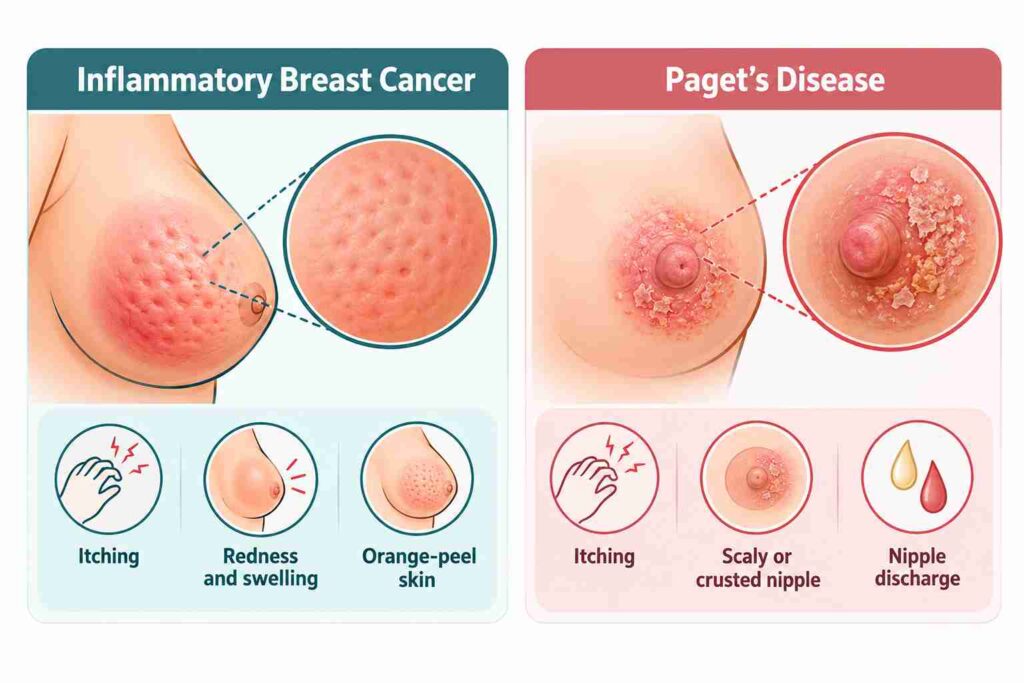
Inflammatory Breast Cancer (IBC): Itching, Redness and Swelling
IBC is a rare, fast-growing cancer. It blocks the lymph channels in the skin of the breast. This makes the breast red, swollen and warm.
The skin can thicken and look like an orange peel. This is called peau d’orange.
Itching with mild redness can be the first sign. IBC often has no lump, and a normal mammogram does not rule it out. Redness that does not improve with antibiotics needs a biopsy.
See a breast specialist if itching comes with any of these:
- Red, pink or purplish breast skin
- Sudden breast enlargement or heaviness
- Breast thickening not linked to weight gain
- Swelling in the armpit from lymph node spread
- A newly inverted nipple
IBC is aggressive, so early diagnosis makes a big difference.
Paget’s Disease of the Breast: Itchy, Scaly Nipple
Paget’s disease affects the nipple and areola. The first sign is often a red, scaly rash that looks like eczema.
It may come and go. The scales can disappear for a while and return. A crust can form again and again. Removing it may cause bleeding.
Paget’s disease may show as:
- Itching of the nipple and areola
- Yellow or blood-stained nipple discharge
- Nipple bruising or bleeding
- An inverted nipple
- A thick, red, crusty patch like eczema
- Tingling or burning around the nipple
Most people with Paget’s also have a cancer inside the same breast. It may be early (DCIS) or invasive.
Itching with crusting could mean stage 0 cancer. If ignored, it can spread into the breast and form a lump. Treatment then becomes harder.
Itchy Breast and Cancer: Key Numbers
| Fact | Figure | Source |
| IBC share of all breast cancers | About 1% to 5% | American Cancer Society data (via HealthDay) |
| IBC stage at diagnosis | Considered at least stage 3 | Same source |
| Paget’s share of all breast cancers | About 1% to 4% | NCI Paget disease fact sheet |
| Paget’s patients with a felt lump | As many as 50% | Same source |
| 5-year survival, Paget’s with invasive cancer | Stage I: 95.8%. Stage III: 46.3% | Same source |
These cancers are rare. But the last row shows why early checks matter.
Skin Rash or Breast Cancer? How to Tell the Difference
| Feature | Common skin rash | Inflammatory breast cancer | Paget’s disease |
| Where | Often both breasts | Usually one breast, large area | Usually one nipple or areola |
| Skin look | Dry, flaky or red patches | Red or purplish, swollen, orange-peel skin | Red, scaly, crusted, may ooze or bleed |
| Lump | Rarely | Often no clear lump | Lump in some cases |
| Response to treatment | Improves with moisturiser or by stopping the trigger | Does not resolve with antibiotics | May improve for a while, then returns |
| Speed | Slow, or linked to a trigger | Fast, over days to weeks | Gradual, may come and go |
Use this table as a guide, not a diagnosis. Only a doctor can confirm the cause.
When Should You See a Doctor for Itchy Breasts?
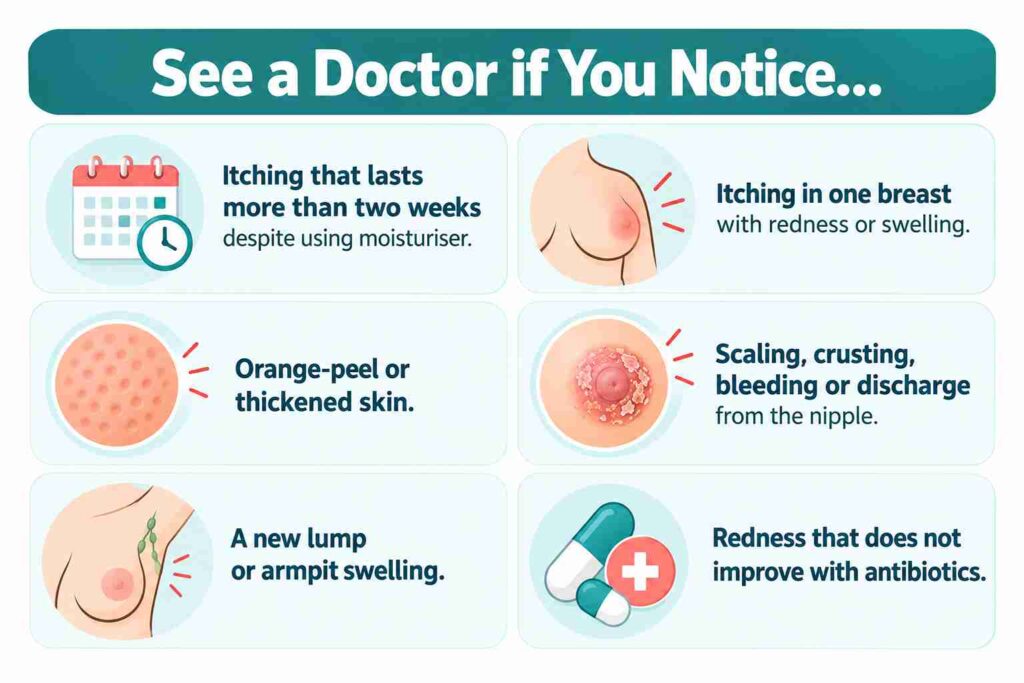
Book a visit if you notice any of these:
- Itching that lasts more than two weeks despite moisturiser
- Itching in one breast with redness or swelling
- Orange-peel or thickened skin
- Scaling, crusting, bleeding or discharge from the nipple
- A new lump or armpit swelling
- Breast looking larger or heavier within days
- Redness that does not improve with antibiotics
Do not wait if you have a family history of breast cancer.
How Is Cancer Confirmed in an Itchy Breast?
Your surgeon will start with a breast exam. Tests may include:
- Mammogram and breast ultrasound
- Skin punch biopsy for suspected IBC
- Nipple scrape or biopsy for suspected Paget’s disease
- Breast MRI to check the extent
- Core biopsy of any lump
What Is the Treatment If Itching Is Due to Cancer?
Treatment depends on the type and stage. For IBC, treatment usually begins with chemotherapy, followed by surgery. Radiation often follows.
For Paget’s disease, surgery is the main treatment. Breast-conserving surgery may be possible in selected cases. A mastectomy may be needed if cancer is more extensive.
Worried About Persistent Breast Itching?
Early checks give you the most options. Dr. Suvadip Chakrabarti can examine you and advise next steps. Book an appointment or call 9330179441.
Itchy Breast FAQs
Can breast cancer cause itching without a lump?
Yes. IBC and Paget’s disease often cause itching and skin changes with no lump. This is why skin changes should never be ignored.
Is itching in only one breast serious?
Not always. But persistent itching in one breast with redness, scaling or swelling needs a check.
Can an itchy nipple be cancer?
Rarely. Eczema and dermatitis are more common. A scaly, crusted or bleeding nipple that keeps returning should be examined.
How long is too long for breast itching?
If it lasts more than two weeks despite basic care, see a doctor. Do not delay if redness or swelling appears.