

Your thyroid is a small, butterfly-shaped gland that sits at the base of your neck, wrapped around your windpipe (trachea). Despite its size, it plays an outsized role in your health — producing hormones that regulate your metabolism, heart rate, body temperature, and blood calcium levels.
Thyroid cancer develops when abnormal cells in this gland begin to grow uncontrollably. The good news is that it's one of the most treatable cancers when caught early — but that also means knowing the early warning signs matters. If you've noticed a lump in your neck, a change in your voice, or persistent throat discomfort, it's worth understanding what these signs could mean and when to consult a specialist.
Who Is at Risk of Thyroid Cancer?
While anyone can develop thyroid cancer, certain factors increase the likelihood:
- Age: Most commonly diagnosed between the ages of 25 and 65
- Gender: Women are diagnosed considerably more often than men
- Radiation exposure: Previous radiation to the head or neck, especially during childhood, raises risk
- Family history: A history of thyroid cancer in the family
Having one or more risk factors doesn't mean you'll develop thyroid cancer — most people who do develop it have no identifiable risk factor at all.
Early Warning Signs of Thyroid Cancer
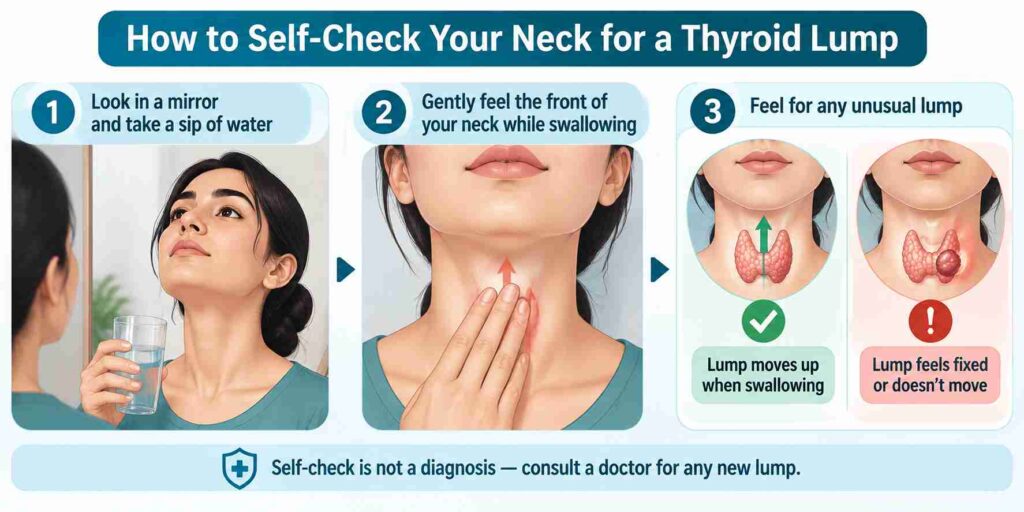
The Most Common Early Sign: A Neck Lump
An unusual lump, nodule, or swelling in the neck is the single most common early sign of thyroid cancer. It typically:
- Appears in the front of the neck, below the Adam's apple
- Is usually painless
- May move slightly up and down when you swallow
It's important to know that most thyroid lumps are not cancerous. Thyroid nodules are common, especially as people age, and the vast majority turn out to be benign. Still, any new or growing lump should be evaluated by a doctor to rule out malignancy.
Other Early Symptoms
Beyond a visible lump, some patients notice subtler early signs:
- Unexplained fatigue
- Hoarseness or voice changes
- Enlarged lymph nodes (glands) in the neck
- A persistent cough not related to a cold, allergy, or infection
These symptoms are easy to dismiss because they overlap with common, harmless conditions — which is exactly why persistent or unexplained versions of them deserve a proper check-up rather than being ignored.
Advanced or Additional Symptoms
As a tumor grows, it can begin to press on nearby structures in the neck, leading to more noticeable symptoms:
| Symptom | What it feels like |
| Neck discomfort | Pain starting at the front of the neck, sometimes radiating to the ears |
| Voice changes | Persistent hoarseness or a raspy voice that doesn't resolve |
| Breathing difficulty | A sensation of "breathing through a straw," especially during exertion |
| Swallowing difficulty | Food or pills feeling like they're getting stuck; pressure when swallowing |
| Persistent cough | Ongoing cough unrelated to illness, caused by nodule irritation |
Is Every Thyroid Lump Cancerous?
No. This is one of the most common concerns patients raise, and it's reassuring: the overwhelming majority of thyroid nodules are benign — often just harmless overgrowths of thyroid tissue or fluid-filled cysts. Only a small percentage turn out to be cancerous.
That said, certain features make a lump more likely to need closer evaluation:
- It's new or growing quickly
- It feels hard or fixed (doesn't move easily under the skin)
- It's accompanied by voice change, breathing trouble, or swallowing difficulty
- There's a family history of thyroid cancer
The only reliable way to know whether a nodule is benign or malignant is through proper testing — not by how it looks or feels alone.
If a nodule is confirmed to be cancerous, it's worth knowing there are different types. Papillary and follicular thyroid cancer are the most common and tend to grow slowly, with excellent treatment outcomes. Anaplastic thyroid cancer is rare but more aggressive and requires urgent evaluation.
Thyroid Cancer vs. Common Thyroid Disorders
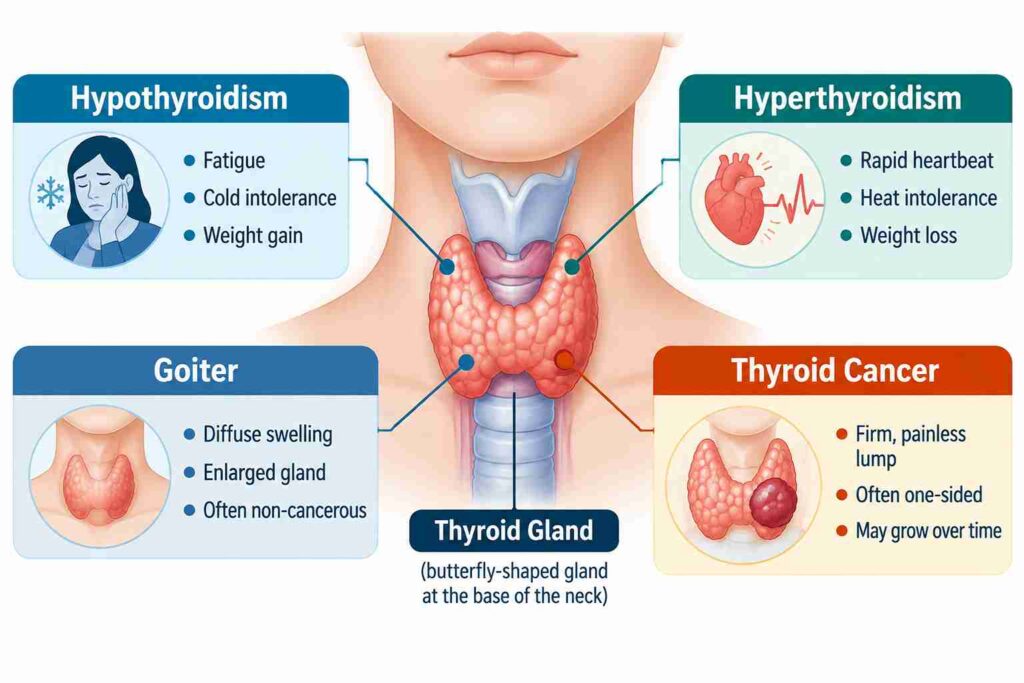
Many thyroid conditions share overlapping symptoms, which can cause confusion. Here's a simple comparison:
| Condition | Typical Presentation | Cancer Risk |
| Hypothyroidism (underactive thyroid) | Fatigue, weight gain, cold intolerance — no lump | Not a cancer risk itself |
| Hyperthyroidism (overactive thyroid) | Weight loss, rapid heartbeat, anxiety — no lump | Not a cancer risk itself |
| Goiter | Diffuse, often symmetric swelling of the whole gland | Usually benign |
| Thyroid nodule | Single, localized lump | Small minority are cancerous |
| Thyroid cancer | Firm, often painless, single lump; may come with voice/swallowing changes | Confirmed only via biopsy |
If you're unsure which category your symptoms fall into, that uncertainty itself is a good reason to get evaluated rather than self-diagnose.
How Is Thyroid Cancer Diagnosed?
If a suspicious lump or symptom is found, your doctor will typically follow a step-by-step evaluation:
Physical Examination
Your doctor will feel the neck for the size, texture, and mobility of any lump, and check for enlarged lymph nodes.
Ultrasound & Imaging
A thyroid ultrasound helps determine whether a nodule is solid or fluid-filled, and identifies features suspicious for malignancy.
FNAC (Fine Needle Aspiration Cytology)
A thin needle is used to extract a small sample of cells from the nodule, which is then examined under a microscope — this is the primary test used to confirm or rule out cancer.
Blood Tests
Tests may be done to check thyroid hormone levels and, in some cases, specific tumor markers.
Thyroid Cancer Survival Rate in India: What to Expect
Indian hospital-based outcome data broadly mirrors the encouraging global picture — most thyroid cancers, especially the well-differentiated papillary and follicular types, have strong long-term survival when treated appropriately.
| Follow-up Period | Overall Survival (Well-Differentiated Thyroid Cancer) |
| 3 years | 94.2% |
| 5 years | 88.8% |
| 7 years | 85.2% |
| 10 years | 82.7% |
A study of survival outcomes in well-differentiated thyroid carcinoma at a tertiary health center in South India reported these 3-, 5-, 7-, and 10-year overall survival rates. The study also found that survival was adversely affected by advanced age (above 55) and more advanced disease at the time of diagnosis. Source: A Study of Survival Outcomes in Well-Differentiated Thyroid Carcinomas at a Tertiary Health Center in South India.
This reinforces the same message as the earlier sections: patients diagnosed and treated at a younger age and earlier stage tend to have meaningfully better long-term outcomes — which is exactly why acting on early symptoms rather than waiting matters.
When Should You See a Doctor?
You should schedule a consultation if you notice:
- A new or growing lump in your neck
- Hoarseness or voice changes lasting more than 2–3 weeks
- Persistent difficulty swallowing or a sensation of food "getting stuck"
- Breathing difficulty not explained by a cold or allergy
- A persistent cough with no infection
- Neck or ear pain that doesn't resolve
Even though most of these symptoms turn out to have benign causes, prompt evaluation — through physical examination, imaging, and if needed, FNAC — is the only way to be sure. Routine follow-ups are also advised for anyone with known risk factors, even without symptoms.
If you notice any of the symptoms discussed above, don't wait for them to worsen. Consult Dr. Suvadip Chakrabarti, Surgical Oncologist in Kolkata, for a proper evaluation and peace of mind. Learn more about thyroid cancer treatment options.
FAQs on Thyroid Cancer Symptoms
Can thyroid cancer be painless?
Yes — in fact, this is the norm rather than the exception. Most thyroid cancer lumps are painless, which is why they're often mistaken for harmless swelling and go unchecked longer than they should.
Does thyroid cancer cause weight changes?
Thyroid cancer itself doesn't typically cause weight changes, since most thyroid tumors don't significantly affect hormone production. Weight fluctuations are more commonly linked to hypothyroidism or hyperthyroidism rather than thyroid cancer specifically.
Is it normal for a neck lump to move when I swallow?
Yes — a lump that moves up and down when swallowing is typical of a thyroid nodule (benign or malignant), since the thyroid gland itself moves with swallowing. This movement alone doesn't indicate whether it's cancerous — that requires proper testing.
How fast does thyroid cancer grow?
Most thyroid cancers, particularly papillary and follicular types, grow slowly — often over months to years. Anaplastic thyroid cancer, which is rare, grows much more rapidly and requires urgent evaluation.