

Fear of recurrence is a major emotional challenge after initial cancer treatment. When breast cancer cells reappear after a period of undetectable disease, it is clinically termed a recurrence. Prompt detection and advanced staging radically alter survival outcomes.
If you observe any physical changes during your recovery, consult an expert breast cancer doctor like Dr Suvadip Chakrabarti immediately for a targeted evaluation.
Breast Cancer Recurrence: Why Does It Happen?
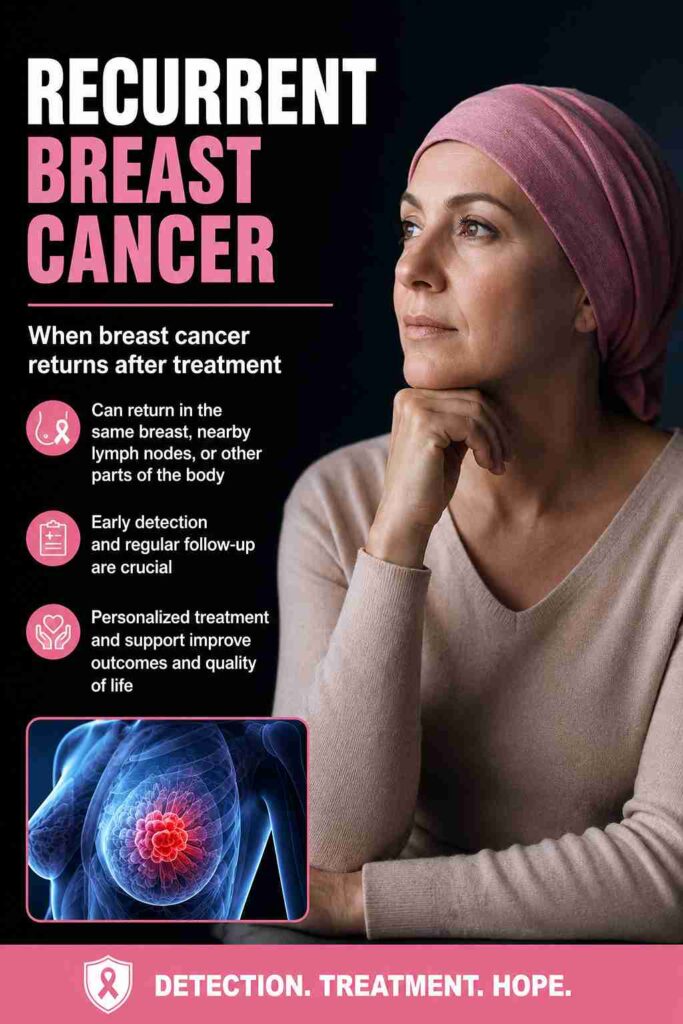
Residual Cancer Cells
- Cellular Survival: Microscopic cancer cells can detach from the primary tumour mass before or during initial surgery.
- Tissue Hiding: These cells hide inside local tissue layers or distant organs, completely evading systemic clearance.
Treatment Resistance
- Genetic Mutations: Some cancer cells possess specific mutations that make them naturally immune to standard therapies.
- Dormant Multiplication: These highly resistant strains survive initial radiation or chemotherapy rounds and slowly multiply over time.
Aggressive Tumour Biology
- Rapid Proliferation: Subtypes like triple-negative breast cancer display rapid cell division and aggressive survival traits.
- Escaping Protocols: This intense biological profile drastically increases their likelihood of escaping standard treatment protocols.
Advanced Staging at Diagnosis
- Baseline Risk: Patients originally diagnosed with higher-stage tumours or extensive lymph node involvement carry a higher initial baseline risk.
- Circulating Cells: More advanced primary disease is directly correlated with a higher volume of circulating microcells in the body.
What Factors Increase the Risk of Breast Cancer Recurrence?
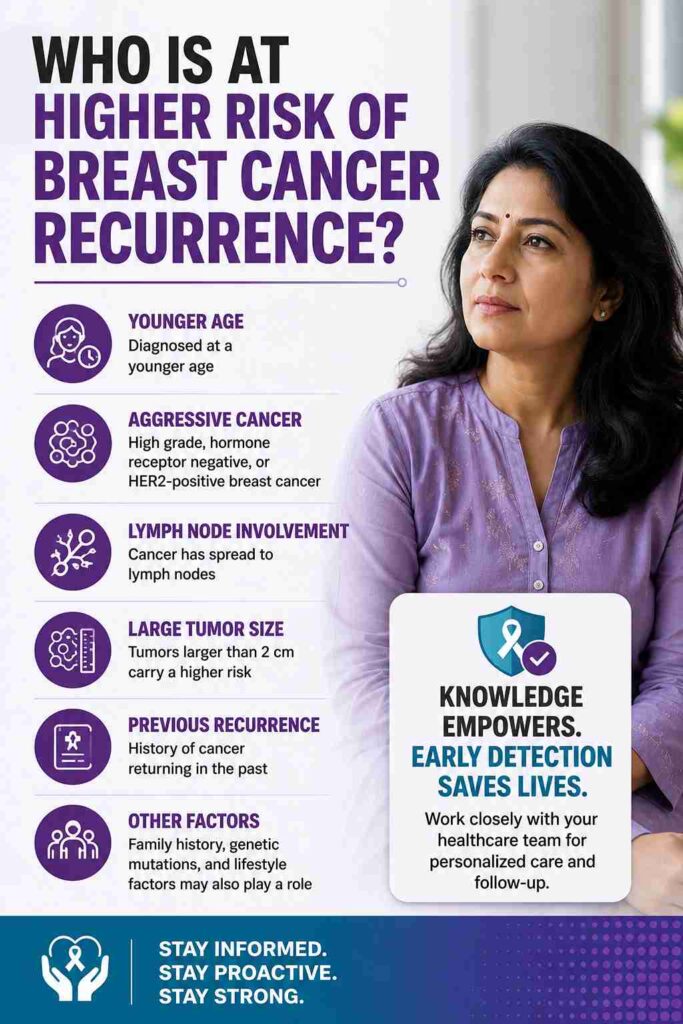
Disease-Related Factors
- Tumour Dimensions: Primary tumour sizes greater than two centimetres significantly elevate the long-term clinical risk profile.
- Nodal Staging: Positive lymph nodes identified during the initial surgery strongly indicate a higher risk of recurrence.
Lifestyle-Related Factors
- Estrogen Stimulation: Chronic post-treatment obesity increases circulating estrogen levels, which can stimulate dormant hormone-receptor-positive cells.
- Immune Weakening: Consistent alcohol consumption, smoking, and physical inactivity actively weaken the body's natural immune surveillance mechanisms.
Which Breast Cancer Types Have the Highest Recurrence Risk?
High-Velocity Subtypes
- Molecular Profiles: Triple-Negative Breast Cancer (TNBC) and HER2-positive variants exhibit the highest propensities for early systemic recurrence.
- Clinical Presentation: Inflammatory Breast Cancer (IBC), an aggressive clinical phenotype characterised by dermal lymphatic invasion, similarly carries an elevated risk of rapid relapse.
- The 5-Year Temporal Peak: Longitudinal oncological data indicate that for receptor-negative cancers (such as TNBC [triple-negative breast cancer]) and some HER2-positive and IBC subtypes, the risk of recurrence peaks sharply within 3 to 5 years post-diagnosis, declining significantly thereafter.
Endocrine-Driven Trajectories & Extended Latency
- Indolent Early Profiles: Conversely, hormone-receptor-positive (ER+/PR+) variants exhibit a much lower early recurrence risk profile.
- Decade-Long Late Recurrence: These endocrine-sensitive variants are characterised by a persistent, linear trajectory of late recurrence. Dormant micro-metastatic cells can reactivate, maintaining a steady risk of late recurrence for 10 to 20 years after the initial diagnosis.
How Common Is Breast Cancer Recurrence?
Overall Recurrence Frequency
- Statistical Averages: Roughly 20% to 30% of breast cancer survivors may face a recurrence, depending heavily on initial staging.
- Individual Variation: The exact frequency fluctuates based on individual risk modifiers, tumour biology, and adherence to systemic treatment.
Adherence Impact
- Endocrine Defence: Adhering strictly to prescribed long-term endocrine therapies significantly lowers these broad statistical averages.
- Survival Preservation: Consistent oral medication use remains the single most effective way to prevent late-stage hormonal recurrence.
When Does Breast Cancer Usually Return?
After Breast-Conserving Surgery (Lumpectomy)
- 5-Year Peak: Local recurrence usually peaks within the first 5 years after a breast-conserving lumpectomy.
- Radiation Safeguard: Adjuvant postoperative radiation reduces the risk of local recurrence by 50% to 70%.
After Mastectomy
- 10-Year Metric: A source reveals recurrence percentages after a full mastectomy drop to roughly 5% to 10% over a ten-year timeline
- Nodal Impact: Extensive lymph node involvement at initial diagnosis significantly raises this specific structural risk.
Types of Breast Cancer Recurrence
Local Recurrence
- Scar Line Return: The cancer returns within the remaining breast tissue or the immediate mastectomy scar layers.
- Chest Wall Skin: Cells can also re-emerge inside the subcutaneous fat layers lining the chest wall.
Regional Recurrence
- Lymphatic Basins: The disease reappears in nearby lymph nodes under the arm or around the collarbone.
- Internal Mammary Nodes: It can also grow behind the breastbone within the internal mammary lymphatic network.
Distant (Metastatic) Recurrence
- Vascular Migration: Cancer cells travel through the vascular network to form secondary tumours in distant vital organs.
- Stage IV Status: This systemic spread represents advanced Stage IV breast cancer requiring comprehensive medical oncology protocols.
Signs & Symptoms of Local Breast Cancer Recurrence
Warning Signs
- Fixed Lumps: A new, painless, firm, or fixed lump within the remaining breast tissue or chest wall scar line.
- Nipple Inversion: Pulling inward, flattening, or sudden structural inversion of the nipple.
- Skin Texture Changes: Unexplained thickening, puckering, dimpling, or redness of the skin over the chest (peau d'orange).
Clinical Advice
- Two-Week Rule: Immediate clinical evaluation is required if any localised skin or tissue changes persist beyond two weeks.
- Scar Verification: Never assume chest wall changes are merely residual surgical scar tissue without a formal scan.
Signs & Symptoms of Regional Breast Cancer Recurrence
Primary Lumps
- Axillary Swelling: Hard, painless swelling or lumps felt deep under the armpit (axilla).
- Collarbone Nodes: New, persistent lumps or swelling located directly above or below the collarbone area.
- Neck Fullness: Continuous discomfort or a distinct feeling of fullness in the lower neck region.
Clinical Advice
- Ultrasound Mapping: Lymph node changes warrant urgent investigation with high-resolution ultrasound.
- Intercepting Migration: Early detection of regional node involvement prevents further distant systemic migration.
Signs & Symptoms of Distant Breast Cancer Recurrence
Bone Metastasis
- Nocturnal Aching: Constant, localised, deep aching bone pain that worsens significantly at night.
- Pathological Fractures: Pain that presents in the spine or pelvis and does not improve with rest.
Lung Metastasis
- Chronic Coughing: A chronic, hacking cough lasting over three weeks without clear cold symptoms.
- Pulmonary Tightness: Progressive shortness of breath during routine activities or localised chest tightness.
Liver Metastasis
- Hepatic Discomfort: Severe loss of appetite, rapid unintended weight loss, and chronic nausea.
- Jaundice & Ascites: Advanced stages present with yellowing of the skin or abdominal swelling (ascites).
Brain Metastasis
- Morning Headaches: New, progressively severe headaches that are frequently worse in the morning.
- Neurological Shifts: Visual disturbances, blurred vision, dizziness, loss of balance, or sudden seizures.
What Should You Do If Symptoms Develop After Recurrent Breast Treatment?

When to Seek Evaluation
- Immediate Action: You must seek a formal medical evaluation immediately if any warning signs manifest during your survivorship phase.
- Preventing Spread: Waiting or ignoring persistent bodily changes can allow a localised issue to spread systemically.
Importance of Assessment
- Early Interception: A prompt assessment ensures that if a recurrence is present, it is intercepted at the earliest possible structural stage.
- Consultations: Scheduling an evaluation with a premier breast cancer doctor such as Dr Suvadip Chakrabarti, guarantees a precise diagnostic workup.
How Is Recurrent Breast Cancer Diagnosed?
History and Examination
- Clinical Review: The diagnostic journey begins with a comprehensive review of your medical history and a meticulous physical examination.
- Targeted Deployment: If structural changes are found, advanced imaging protocols are deployed sequentially.
Imaging Modalities
- Mammography Links: Mammograms and ultrasounds serve as primary tools to visualise structural density changes in remaining tissue.
- PET-CT Precision: Full-body PET-CT scans are utilised to detect metabolic shifts and rule out distant metastatic spread.
Biopsy & Biomarker Testing
- Mandatory Biopsies: If imaging confirms an abnormal mass, a core needle biopsy is completely non-negotiable.
- Receptor Mutation: Tissue samples undergo comprehensive biomarker testing to check for shifts in ER, PR, and HER2 status.
Treatment Options For Recurrent Breast Cancer
Selection Factors
- Precise Profiling: Treatment selection depends entirely on your recurrence type, previous therapies, and updated biomarker statuses.
- Multidisciplinary Design: Plans balance maximum clinical efficacy with your current overall physical health.
Treatment for Local Recurrence
- Surgical Revisions: If the patient previously underwent a lumpectomy, a complete total mastectomy is typically recommended.
- Salvage Radiation: This is paired with salvage radiation if the chest zone was not irradiated before.
Treatment for Regional Recurrence
- Nodal Clearance: Treatment requires complete surgical clearance of the affected lymph node basins.
- Systemic Swaps: This approach involves targeted radiation and adjustments to systemic therapy.
Treatment for Distant Recurrence
- CDK4/6 Blockers: Therapy shifts toward systemic control using hormone blockers combined with CDK4/6 inhibitors.
- Biological Smart Bombs: Advanced anti-HER2 antibody-drug conjugates (Trastuzumab Deruxtecan) are used to destroy mutated cells.
Can Recurrent Breast Cancer Be Treated Successfully?
Prognosis Overview
- Curative Pathways: Local and regional recurrences are treated aggressively with definitive curative intent, yielding long-term survival.
- Chronic Management: Distant metastatic disease is managed effectively as a controllable, chronic illness for many years.
Advanced lines of Therapy
- Targeted Breakthroughs: Tremendous advances in targeted smart drugs enable patients to maintain an excellent quality of life.
- Resistance Rotation: Modern protocols allow oncologists to rotate lines of therapy seamlessly if resistance develops.
Why Follow-Up Care Remains Important
Why Surveillance Matters
- Primary Safety Net: Rigorous post-treatment surveillance acts as your primary safety net against dormant cell activation.
- Early Interception: The core goals of follow-up care are to intercept local recurrences early and manage treatment-related side effects.
Components of Follow-Up Care
- Scheduled Screenings: Components include scheduled clinical exams, annual mammograms, and regular blood panels.
- Protocol Alignment: Partnering long-term with an expert breast cancer doctor ensures your monitoring protocols align with international guidelines.
Let’s Recap
- Recurrent breast cancer develops from microscopic cancer cells that survive initial treatment and later grow again.
- Breast cancer recurrence may be local, regional, or distant, with symptoms varying by recurrence site.
- New breast lumps, swollen lymph nodes, persistent pain, or unexplained weight loss require prompt medical evaluation.
- Diagnosis relies on clinical examination, imaging, biopsy, and updated biomarker testing to guide treatment.
- Treatment is personalised and may include surgery, radiation, chemotherapy, hormone therapy, targeted therapy, or immunotherapy.
- Regular follow-up helps detect recurrence early, monitor recovery, and support timely treatment decisions.
Speak with Dr Suvadip Chakrabarti, a leading breast cancer doctor in Kolkata, for expert guidance today
If you are experiencing unusual changes or need a comprehensive survivorship surveillance plan, call 093301 79441 for an appointment today.
People Also Ask
Can breast cancer return after 10 years?
Yes. Hormone-receptor-positive (ER+) breast cancers are biologically known for late recurrences, sometimes returning 10 to 20 years after initial treatment.
What are the earliest signs of breast cancer recurrence?
The earliest signs include a new firm lump along the surgical scar, targeted skin puckering, persistent bone pain, or a chronic dry cough.
Is recurrent breast cancer always stage 4?
No. If the cancer returns strictly to the original breast tissue or nearby lymph nodes, it is classified as a local or regional recurrence, not stage 4.
Can recurrent breast cancer be cured?
Local and regional recurrences can often be completely cured with surgery and radiation. Metastatic recurrence is highly treatable as a long-term chronic condition.
Does every new breast lump mean recurrence?
No. Lumps can be caused by benign surgical fat necrosis, scar tissue formation, or fluid collections like seromas, but they must be evaluated by a doctor.
How often should breast cancer survivors have follow-up visits?
Survivors typically undergo follow-up clinical exams every 3 to 6 months for the first several years, transitioning to annually after year five.
When should you consult a breast cancer doctor?
Consult an expert immediately if you notice any new lumps, persistent localised pain, chronic coughing, skin changes, or unexpected neurological symptoms