
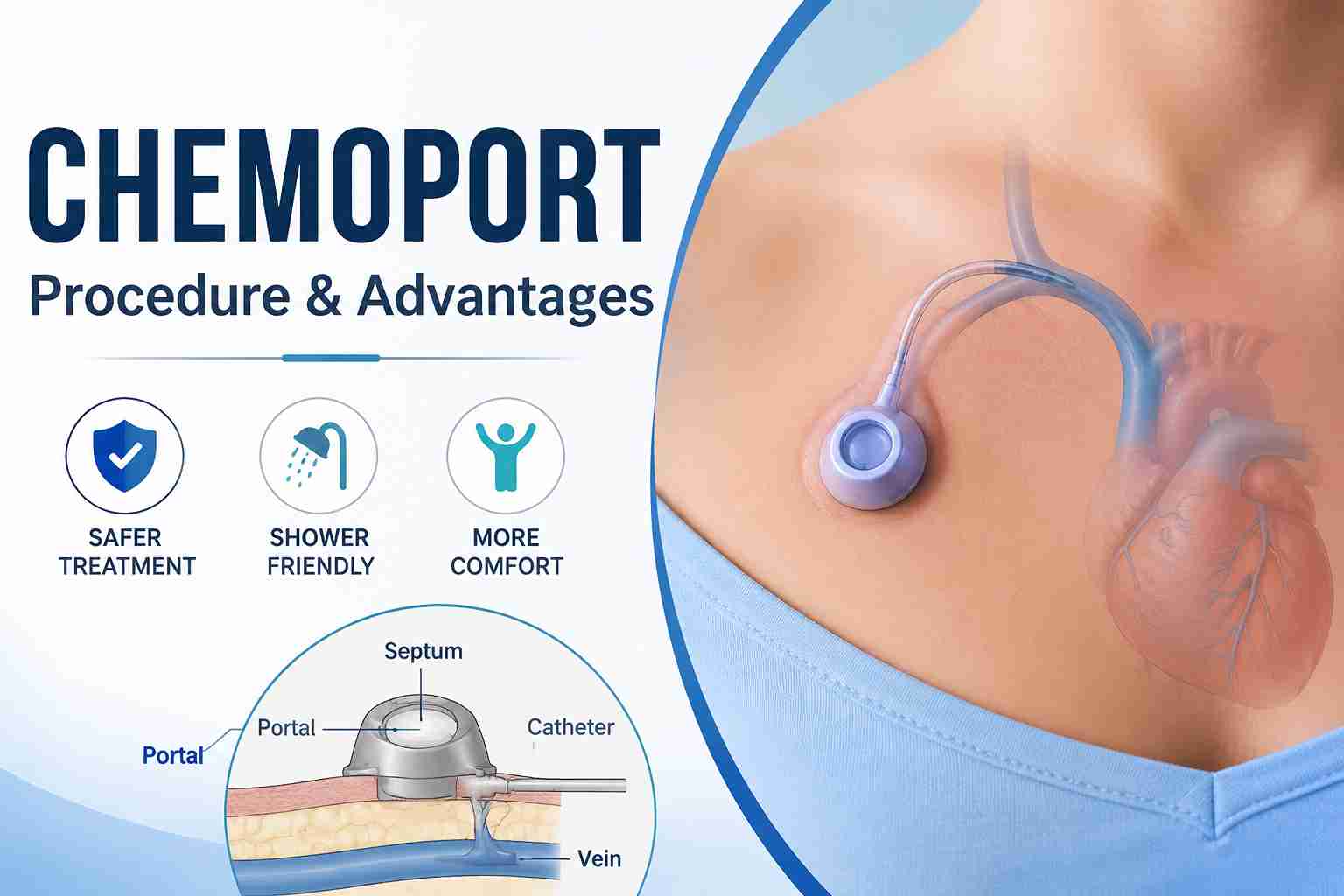
A ChemoPort is a small implantable device placed under the skin. It gives chemotherapy medicines a direct path into a large vein. This avoids repeated needle sticks in your arm during every chemo cycle.
Many patients starting chemotherapy ask the same question: "Do I really need a port?" This guide answers that, plus pain, risks, and aftercare — so you can discuss it confidently with your oncologist.
What Is a ChemoPort?
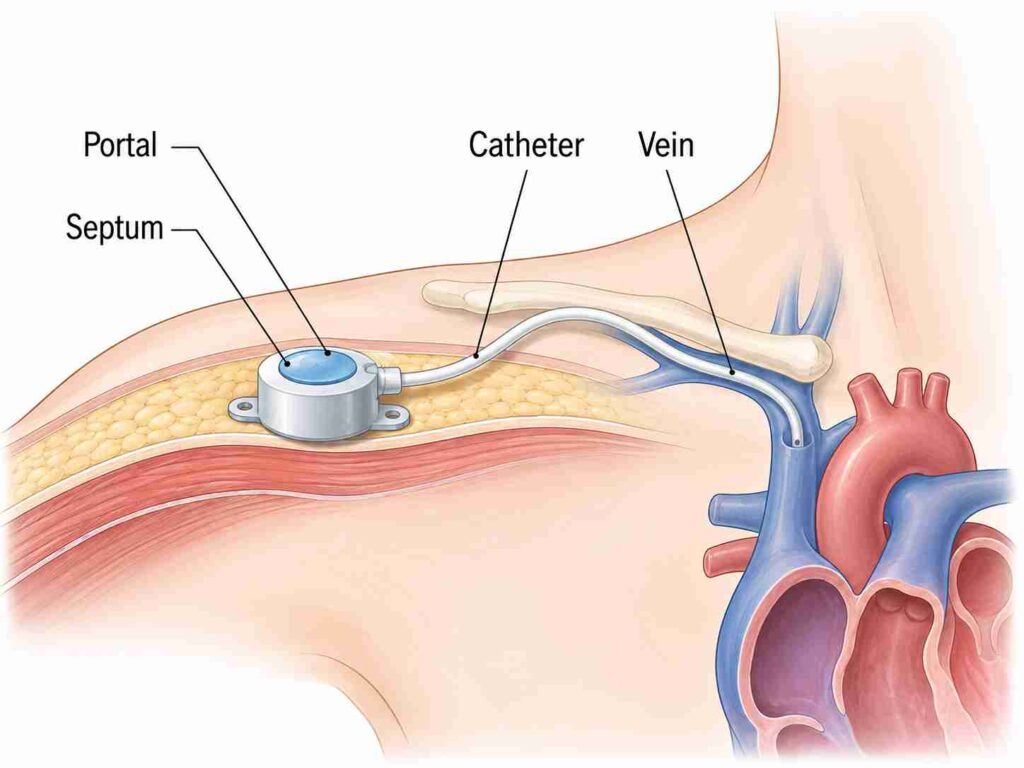
A ChemoPort (also called a Port-a-Cath) has two parts:
| Part | Function |
| Portal | A small metal or plastic disc placed under the skin, usually on the upper chest |
| Catheter | A thin silicone tube connecting the portal to a large vein (subclavian or jugular) |
| Septum | A self-sealing rubber center where the needle is inserted for each session |
Once healed, the port sits completely under the skin. You'll notice only a slight bump.
How Is a ChemoPort Inserted? Step-by-Step Procedure
The insertion is a same-day, minor surgical procedure, usually done under local anaesthesia.
- A 1–2 inch incision is made, typically on the upper chest.
- The small portal disc is placed just under the skin.
- A catheter is threaded into the subclavian or jugular vein, ending near the top of the heart.
- An X-ray confirms the catheter tip is correctly positioned.
- The site is closed, and you go home the same day.
Most surgeons prefer placing the port at least one week before chemotherapy starts, to reduce complication risk. It can also be inserted during the same sitting as a cancer surgery, such as a mastectomy.
Is ChemoPort Insertion Painful? What to Expect
The procedure itself is done under local anaesthesia, so you stay awake but numb at the site. Most patients feel pressure, not sharp pain.
- The full procedure takes 30–45 minutes.
- Mild soreness at the site is normal for a few days.
- Each chemo session after that needs only a single needle stick into the port — not a vein search.
ChemoPort vs IV Line: Which Is Better for Chemotherapy?
This is one of the most common questions patients ask before their first cycle.
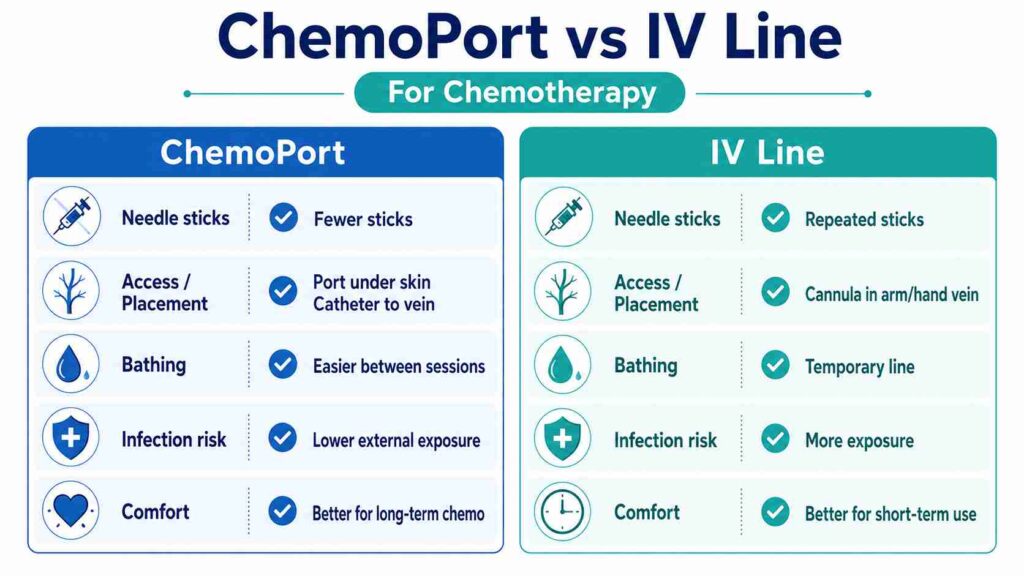
| Factor | ChemoPort | Peripheral IV Line |
| Needle sticks per cycle | 1 (into port septum) | Repeated vein search each time |
| Vein damage over time | Minimal | Common with long-term use |
| Bathing / swimming | Safe once healed | Restricted while IV is in place |
| Long-term chemo (months+) | Well suited | Becomes harder over time |
| Infection route | Lower with proper care | Higher with repeated punctures |
| Complication rate | Roughly 7–12.5% (mostly minor, manageable) | Higher rates of extravasation, phlebitis, infection |
Clinical studies comparing the two access methods found that chemoports result in fewer severe complications and are preferable for long-term chemotherapy administration (source study).
Advantages of ChemoPort for Cancer Patients
- Single needle stick per session instead of hunting for a vein each time.
- Lower risk of leakage (extravasation) of chemo drugs into surrounding tissue.
- Bathe and swim normally once the site has healed — the port is fully internal.
- Faster prep time for nurses, meaning shorter waiting before infusion starts.
- Useful beyond chemo — can also be used for blood draws, IV fluids, and antibiotics.
- Minimal maintenance — needs periodic flushing, not daily care.
How Long Can a ChemoPort Stay in the Body?
A ChemoPort can safely remain in place for months to several years, depending on how long your treatment continues. In one large single-centre review, the average duration of chemoport use was 481 days (source study).
It is removed once your oncologist confirms it is no longer needed — this is a quicker, simpler procedure than insertion, usually done under local anaesthesia alone.
Who Needs a ChemoPort? Cancers That Commonly Require One
A port is usually recommended for patients on chemotherapy lasting several months, across cancer types including:
- Head and Neck Cancer (oral, throat, thyroid, tongue)
- Breast Cancer, especially patients on extended maintenance therapy
- Gynecologic Cancer, including cervical and ovarian cancer
- Stomach Cancer, Colon Cancer, and Rectal Cancer
- Patients undergoing CRS+HIPEC Surgery, who often need long-term venous access
Your treatment team will assess whether a port fits your specific chemotherapy plan.
Risks and Complications of ChemoPort: What Studies Show
ChemoPort insertion is generally very safe, but like any minor surgery, it carries some risk. A review of chemoport complications found the overall complication rate has been reported to be 7.2–12.5%, with port system infection being the most common (source study).
Possible complications include:
- Infection at the port site or along the catheter
- Catheter blockage or malposition
- Thrombosis (blood clot near the catheter)
- Rare cases of catheter dislodgement
Caring for Your ChemoPort After Insertion
- Do keep the site clean and dry until fully healed.
- Do get it flushed with saline/heparin as scheduled, even between chemo cycles.
- Do report redness, swelling, fever, or pain immediately.
- Don't apply pressure, heavy bags, or seatbelts directly over the port.
- Don't ignore a stiff or painful arm on the port side.
When Should You Talk to an Oncologist About a ChemoPort?
If your chemotherapy plan spans several months, or your veins are becoming hard to access, this is worth discussing before your next cycle — not after complications start.
Book a consultation to check if a ChemoPort is right for your treatment plan.
Related Reading
- What Happens When Breast Cancer Returns? Signs, Symptoms & Treatment Options
- Is Stage 4 Cancer Always Untreatable? What Modern Oncology Says
Frequently Asked Questions
Can I bathe or swim with a ChemoPort?
Yes, once the incision has fully healed, the port is completely under your skin and safe for bathing or swimming.
Does ChemoPort removal hurt?
Removal is simpler than insertion. It's done under local anaesthesia and usually causes only mild, short-lived discomfort.
Is a ChemoPort necessary for every chemotherapy patient?
No. It's typically recommended for patients needing chemotherapy over several months, or those with difficult vein access.
Can the same ChemoPort be used if chemotherapy restarts later?
If it was not removed and remains functional, yes — your oncologist will check it before reuse.